|
A heat pump is an electric device that supplies a building's demand for thermal end uses without the combustion of fossil fuels. Five applications consume secondary energy in a home: space heating, water heating, space cooling, lights, appliances. Canada's energy department estimates that 15.3 million households (all dwelling units) consumed 405 billion kWh in 2022 (1,461 PJ) of which the first three thermal applications consumed 328 billion kWh (81% of energy). These households emitted 56 billion kg (56 Mt) of carbon, of which thermal applications emitted 48 billion kg (87% of emissions). This means the average household across Canada consumed 26,401 kWh of energy, of which 21,307 kWh was for thermal applications (13 kWh per ft2), and emitted 3,627 kg of carbon, of which 3,148 kg was from thermal applications (2 kg per ft2). This will vary depending on geographic location, dwelling size, design, number of occupants, etc. What are the options? (before considering any supply option, follow the Rule of 3C as much as possible) Heat pumps produce thermal heat from the air or from the ground / water. They consume conventional electricity to operate a compressor, pumps & motors, and the efficiency of a system is the ratio of energy produced vs energy consumed to produce the output, rated as EER (energy efficiency ratio) or COP (co-efficient of performance). An Air Source Heat Pump (ASHP) funnels outside air through a coil where a compressor extracts the thermal energy for distribution inside the building. In summer, it absorbs the warmth from inside air for discharge outside, thereby providing space cooling. The efficiency of an ASHP declines with outdoor temperature and the exterior unit can be quite noisy, but the cost to install is lower than other options and is suitable for renovations. A Ground Source Heat Pump (GSHP) buries pipe in the ground (horizontal loop or vertical borehole) to circulate a fluid that is warmed by the earth before it returns to a compressor that circulates the heat into the building. In summer, the direction is reversed to take warm air out of the building for ejection into the ground. A Water Source Heat Pump uses the same process but relies on water as the heat source or heat sink. A GSHP is more expensive to install because of the cost to dig loops or boreholes (lower in new construction before the landscaping is finished) but it performs efficiently in any ambient temperature and makes no noise.
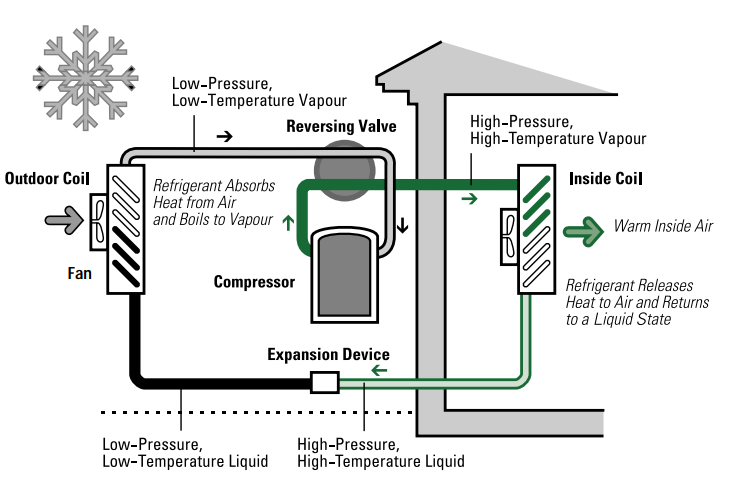
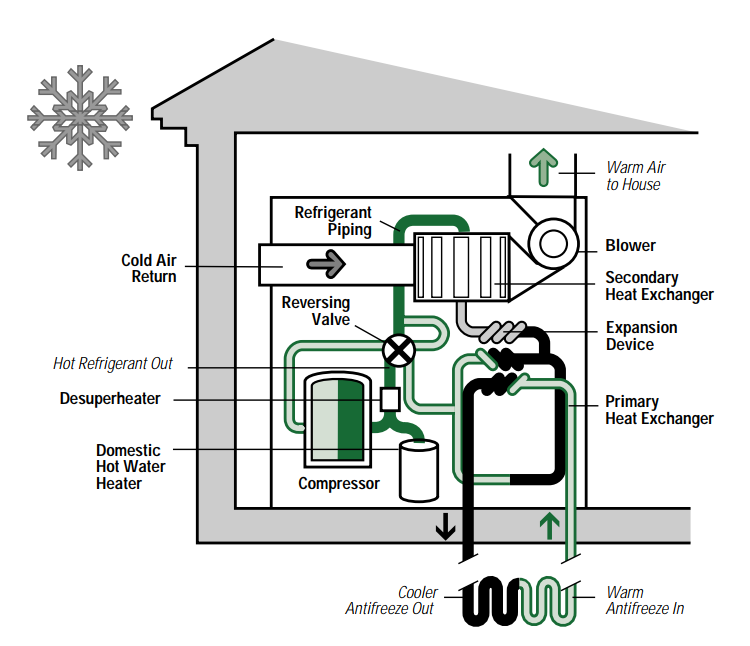
Government schematics show how ASHP & GSHP produce thermal energy for buildings. ASHP or GSHP will produce that 21,307 as dispatchable (no battery required) renewable energy. Depending on their EER / COP, a system will require from 7,000 to 11,000 kWh per year. If the grid electricity is generated from non-combustion sources, the dwelling would reduce annual carbon emissions by 3,148 kg. Heat pump technology offers many benefits to the building owner, the economy & the environment, but the industry needs to quantify its production of thermal output in kWh so consumers have a clear comparison of supply options. That measure would allow a PTC (Production Thermal Credit) or a T-REC (Thermal Renewable Energy Credit) to incent on-going operational efficiency and to avoid reliance on price-skewing installation grants. It would also allow a home to verify that it produces 21,307 kWh of renewable energy, compared to its annual consumption of 11,000 kWh (worst case scenario), in order to be classified as NetZeroPLUS. |